
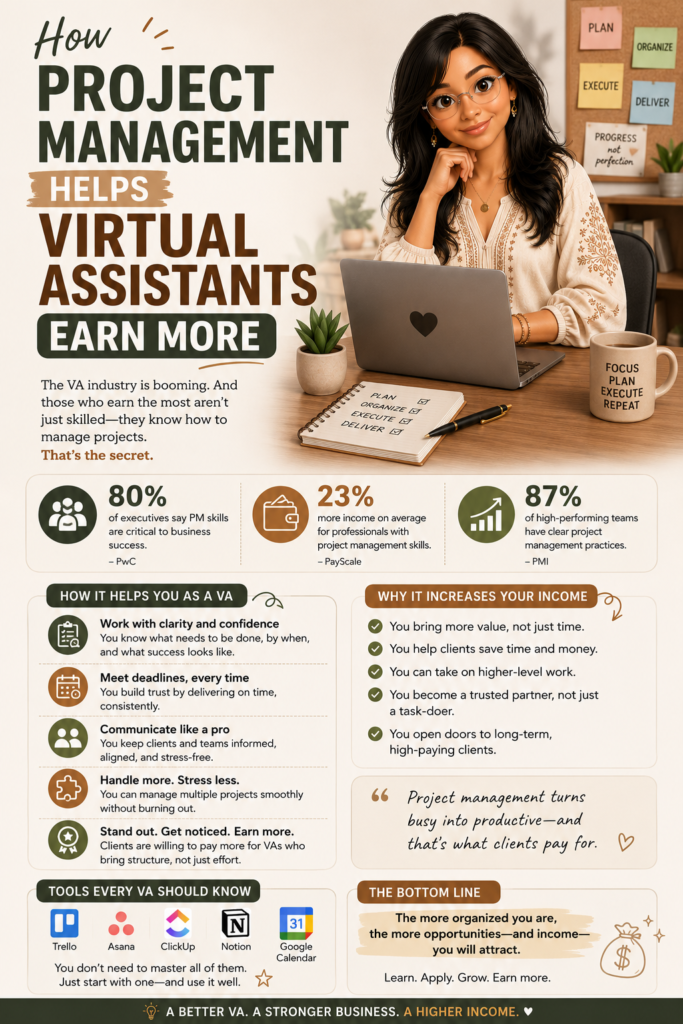
For Virtual Assistants, project management is no longer just a “nice-to-have” skill. It is what helps you move beyond simply completing admin tasks and become someone a client can truly rely on to keep operations organised, deadlines on track, and projects moving forward.
This matters because remote work, freelancing, and platform-based jobs are already a major part of the workforce, especially in regions where many VAs are based.
The World Bank estimates that there are between 154 million and 435 million online gig workers worldwide. That could represent as much as 12% of the global workforce, spread across 545 platforms connecting workers and clients in 186 countries.
South Asia is one of the biggest contributors to this workforce. India, Bangladesh, and Pakistan account for more than half of the measured supply of online gig workers. India alone had around 7.7 million gig workers in 2020 to 2021, and NITI Aayog expects that number to reach 23.5 million by 2029 to 2030.
The Philippines also has a large and growing pool of online professionals. One widely cited estimate placed around 1.5 million Filipinos on international freelance platforms. OnlineJobs.ph now reports that employers can search through more than 5 million Filipino profiles.
In Latin America, Workana says its platform supports around 3 million freelancers and more than 600,000 companies and entrepreneurs.
These numbers do not represent VAs alone, but they give us a clear picture of how large the remote and freelance talent market has become. They also show why VAs need more than basic administrative skills to stand out. Project management gives them a stronger advantage by showing clients that they can organise work, solve problems, manage priorities, and help keep the business running smoothly.
Source: Working Without Borders by World Bank
Why PM Skills are a Differentiator
Research also shows why project management skills can make such a big difference.
In a survey of college-educated workers across 40 countries, working from home did not disappear after the pandemic. It simply became more stable. By late 2024 and early 2025, employees were still working from home an average of 1.23 days per week worldwide, which remains much higher than pre-pandemic levels.
PMI also found that project teams can perform just as well whether they work onsite, remotely, or through a hybrid setup. In its 2024 Pulse of the Profession report, the average project performance rate was 73.8%.
But the setup alone does not guarantee good results. What really matters is how well the work is organised, communicated, and managed.
PMI’s 2025 research found that project professionals with strong business understanding consistently performed better. They were more likely to meet business goals, stay on schedule, and remain within budget. They also had a lower project failure rate.
The difference may look small at first, but it becomes significant across multiple projects:
- 83% versus 78% in meeting business goals
- 63% versus 59% in staying on schedule
- 73% versus 68% in staying within budget
- 8% versus 11% in project failure
Asana also found that knowledge workers spend around 60% of their time on what it calls “work about work.” This includes unnecessary meetings, duplicated tasks, endless updates, and conversations about work instead of actually completing it.
Over one year, that can add up to 103 hours in unnecessary meetings, 209 hours repeating work that has already been done, and 352 hours simply discussing work.
These findings highlight where project management skills can make a real difference for virtual assistants. Remote teams can perform well, but good results still depend on clear coordination, sound decisions, and an understanding of how the work supports the business. A VA who develops these abilities can contribute beyond task completion and become more involved in successful project delivery.
Source: The Global Persistence of Work from Home
The Money Angle
There can also be an income advantage.
Reliable salary data specifically comparing regular VAs with VAs who have project management skills is still limited across different regions. Because of that, the safest way to look at the earning potential is through related job categories.
Based on Upwork’s published rate ranges, Virtual Assistants typically charge around $10 to $20 per hour. Project Coordinators are listed at about $25 to $45 per hour, while Project Managers are commonly priced between $19 and $45 per hour.
This shows that clients are often willing to pay more when a VA can take ownership of timelines, priorities, follow-ups, and overall delivery, instead of simply waiting for tasks to be assigned.
Using the midpoint of these published ranges, roles connected to project management are priced at roughly 2.1 to 2.3 times higher than standard VA work.
Of course, this does not mean every VA with project management skills will automatically earn twice as much. Rates still depend on experience, industry, location, client budget, and the level of responsibility involved. Still, the numbers suggest that learning how to manage projects can help a VA move into higher-value roles and build a stronger case for better rates.
Source: Upwork Hourly Rates: Average Rates by Skill and Experience in 2026
The Mindset Shift
The biggest mindset shift is this: a VA does not become more valuable simply by doing more tasks. A VA becomes more valuable by making work easier to manage and more predictable for the client.
The biggest change starts with how you look at your role.
A task-focused VA asks, “What do I need to finish today?” A project-minded VA also asks, “What result are we trying to achieve, what could affect it, and what does the client need to know?”
This does not mean making every decision for the client or taking control of work outside your role. It means understanding how your responsibilities connect to the bigger goal. You begin to notice when one delayed approval could affect several tasks, when priorities no longer match the deadline, or when the team is working with outdated information.
This mindset is especially useful when working with clients and team members across different countries and time zones. Since everyone may not be online at the same time, clear context and documented decisions become more important than constant meetings and messages.
The goal is not to make yourself busier. It is to become someone who understands what the work is trying to achieve and helps the client avoid unnecessary surprises.
What Project Management Looks Like in a VA Role
Project management in a VA role often appears in work that already feels familiar.
A social media VA may coordinate the full content cycle, from gathering ideas and requesting graphics to securing approval and scheduling posts. An executive VA may prepare meetings, track decisions, follow up on action items, and make sure responsibilities are not forgotten. A real estate VA may coordinate listings, documents, inspections, and communication among clients, agents, and service providers.
The same applies to website launches, podcast production, recruitment, client onboarding, email campaigns, webinars, and other work with several connected steps.
In each case, the VA is not only completing an individual assignment. They are helping different people, decisions, and deliverables come together at the right time.
You do not need to manage a large team or hold the official title of Project Manager to do this. Project management can begin with something as simple as taking responsibility for one small workflow from start to finish.
Task Management vs. Project Management
Task management and project management work together, but they focus on different things.
Task management is concerned with individual pieces of work. It answers questions such as: What needs to be completed? Who is responsible? When is it due?
Project management looks beyond each item and asks whether all the work is leading towards the intended result.
For example, uploading a blog post is a task. Managing blog production is a project. The full process may involve research, writing, editing, graphic design, approval, publishing, and promotion. Each task can be completed separately, but the project succeeds only when those parts come together properly.
Here is a simple comparison:
A VA can be excellent at completing tasks without yet managing projects. The difference begins when you connect individual assignments to a shared outcome and measure success by more than the number of boxes checked.
Project management tools can support either approach. What matters is how you use the information inside them.
A Realistic Before-and-After Example
Imagine that a client is preparing to launch an online webinar in three weeks.
The VA receives separate requests to create a registration form, prepare social media graphics, upload the speaker’s information, and schedule reminder emails. The VA completes each request as it arrives.
However, the speaker’s final details come in late. The landing page cannot be completed, so promotion also starts late. The email schedule needs to be adjusted, and the client only realises how much the delay has affected when the launch date is already close.
The VA completed the assigned tasks, but nobody was looking at how those tasks depended on one another.
Now imagine that the VA treats the webinar as one connected project.
At the beginning, the VA identifies the major steps, the information needed from the client, and the decisions that could affect the schedule. When the speaker’s details are delayed, the VA raises the issue early and explains which deliverables will be affected. The client can then follow up, approve a temporary version, or adjust the plan before the delay becomes urgent.
The VA may still be using the same technical skills, but the level of support is different. Instead of reacting to separate requests, the VA is helping the client understand what is happening and make decisions while there is still time to act.
That is the practical difference between completing project-related tasks and helping manage the project itself.
Learn Effective Project Management Strategies
Practical Toolkit for VAs
A simple way to learn project management is to create a single, clear, and repeatable system for the work you are already doing. You do not need to make it complicated or use every feature in a project management tool.
Start with this simple process:
- Keep everything in one place.
Choose one main workspace, such as Trello, Asana, ClickUp, Notion, or monday.com. Avoid keeping some tasks in chat, others in email, and the rest in your personal notes. When everything is scattered, important details are easier to miss. - Use a clear task format.
Every task should answer four basic questions: What needs to be done? Who is responsible? When is the deadline? What does a completed task look like? - Create a simple status flow.
You do not need a complicated board. A good starting point is: Inbox, Planned, In Progress, Waiting on Client, and Done. - Review your tasks every week.
Set time each week to check overdue work, upcoming deadlines, blockers, and tasks that still need client approval. This helps you catch problems before they become urgent. - Send one clear status update.
Keep your client updates simple and easy to scan. You can use this format: Done this week, In progress, Waiting on you, and Next up. - Document tasks that keep repeating.
Turn regular tasks into SOPs, checklists, or templates. This saves time, improves consistency, and prevents you from starting from scratch every time.
Useful starter templates for VAs can include a client intake form, weekly status report, content calendar, meeting notes with action items, client onboarding checklist, and a simple risk or blocker log.
A good rule to follow is this: if you have done the same task three times, create a template for it.
PM Tools Pricing Comparison
You do not need the most expensive or feature-packed project management tool to work effectively. The best tool is the one that matches the type of work you handle, feels comfortable to use, and is simple enough for both you and your client to maintain consistently.
Most VAs can start with a free plan and upgrade only when they genuinely need more features, users, storage, or automation. The comparison below looks at the entry cost, learning curve, and best use case of popular project management tools to help you choose the right starting point without making the process more complicated than it needs to be.
Next Steps
You do not need to wait until you have the title of Project Manager before you begin developing this skill.
Start with one workflow you already understand well. It could be client onboarding, monthly content production, lead follow-up, podcast publishing, or another process you regularly support. Study how the work moves from the first request to the final result, then look for places where responsibilities, decisions, or expectations are unclear.
You can strengthen this practical experience through a structured project management learning path that introduces planning, communication, risk, timelines, and project delivery in a more organised way.
As you improve, keep evidence of what you have built. Save sample timelines, project boards, progress reports, workflows, and templates that demonstrate how you approach work. When possible, document the problem you helped solve and the result your system produced.
Project management is not about suddenly taking on a more impressive title. It is about gradually becoming more capable of handling responsibility, understanding outcomes, and supporting clients at a higher level.
You can start practising that with the work already in front of you.
Learn Effective Project Management Strategies